
There are about 130 million German speakers in the world, and Germany alone
accounts for 83 million of them. It's the largest economy in Europe, the
fourth largest globally, and it sits at the centre of every cross-border
project on the continent — from the Renault-Nissan-Mitsubishi alliance
boards to Airbus's wing factories in Bremen.
So the question isn't really whether learning German is useful. It's
which kind of useful applies to you. After eight years teaching at our
school in Bochum we've grouped the answer into seven concrete reasons. Pick
the ones that match your life — the rest is just bonus.
1. Your CV gets a different shape
German companies pay well, hire long-term, and prefer candidates who can
work in their language. According to the Federal Employment Agency
(Bundesagentur für Arbeit) there were over 1.7 million open positions
in Germany in early 2026 — concentrated in healthcare, engineering, IT,
construction, and skilled trades.
A few facts that make the difference between "I should learn German" and
"I'm enrolling next month":
- The Skilled Workers Immigration Act (Fachkräfteeinwanderungsgesetz)
fast-tracks visas for non-EU candidates with a recognised qualification
and B1 German. - The EU Blue Card threshold drops dramatically (€43,800 instead of €56,400 for shortage occupations) when you bring solid German.
-
Salary research from Stepstone consistently shows a 5–15% premium
for bilingual German+English candidates over English-only ones in the
same role.2. Public universities are essentially free — if you can study in German
Germany's public universities charge a "semester fee" of €150–350 that
covers transport, student services, and administration. That's it. No tuition. International master's programmes in Munich, Berlin, Heidelberg
and Aachen routinely place in the global top 100, and a fully German-
language degree is open to anyone with the right papers and C1 (or
TestDaF / DSH) German.If you've ever looked at US or UK tuition fees, you know what €0 vs. €60,000
a year means in real terms.3. Medical careers — the fastest path is German
Germany has a chronic shortage of doctors, nurses, and Pflegekräfte. For
internationally trained medical professionals the path runs through language: the Fachsprachprüfung (FSP) at B2-C1 level for doctors, and
the B2 Pflege or telc Deutsch B1·B2 Pflege for nurses. Without those,
recognition (Approbation) doesn't happen.We have an entire course dedicated to that pathway —
German for Medical Professionals —
because the difference between general B2 and clinical B2 is the
difference between small talk in the cafeteria and taking a patient
history during an ISBAR hand-over.
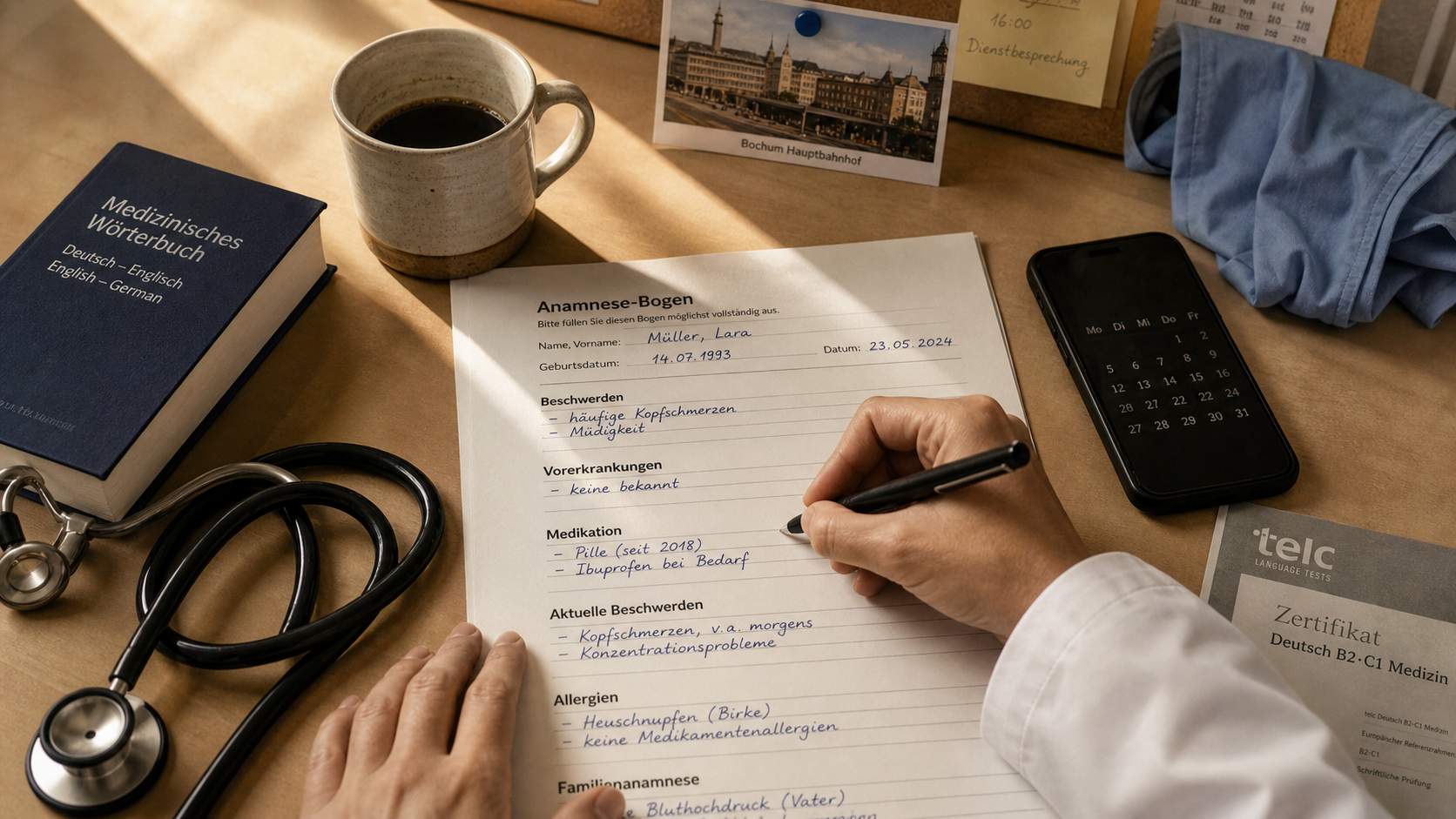
4. Bildungsgutschein: someone else pays for the course
If you live in Germany and you're job-seeking, retraining, or facing
unemployment, the Bundesagentur can issue a Bildungsgutschein that
covers a German course in full at any AZAV-certified provider — like us.
Self-employed and at-risk-of-unemployment candidates may qualify for an
AVGS voucher. We see students every month who walk in expecting to
pay €1,500 and walk out with a fully funded place.
This is a uniquely German feature of adult education and it's massively
underused by non-Germans simply because nobody told them it existed.
5. Mobility across three countries, not one
German is the official language of Germany, Austria, the most populous
parts of Switzerland, Liechtenstein, and parts of Belgium and South Tyrol.
Pass a telc B2 in Bochum and you can interview in Vienna and Zürich
without retaking anything.
That's roughly 100 million native speakers across the DACH region,
plus economically interlocked neighbours (Czech Republic, Poland, the
Netherlands) where German is the most common second business language
after English.
6. Daily life in Germany still happens in German
A common misconception: "Everyone in Germany speaks English." The
working population in Berlin and Munich — yes, mostly. The Finanzamt
clerk you'll deal with about your residence permit, the Hausarzt's
receptionist, the Hausmeister, the customer-service line at your
internet provider, the form you'll fill at the Standesamt to get
married, the school enrolment paperwork for your children — those happen
in German. Always.
Living in Germany without German is possible. Living well in Germany
without German is much rarer than the cliché suggests.
7. Studying German is also studying European thought
A more reflective reason, but a real one. Some of the most influential
ideas of the last 250 years — Kant, Hegel, Marx, Nietzsche, Freud,
Einstein, Heisenberg, Hannah Arendt — were first written in German.
Reading any of them in translation is like watching a film with the
soundtrack muted: you get the picture but you miss half the texture.
Same for music (Bach, Beethoven, Brahms, Mahler, Wagner) and
contemporary literature (Herta Müller, Jenny Erpenbeck, Daniel Kehlmann).
The level you need to read modern non-fiction is roughly B2; for poetry
and 19th-century philosophy, expect to be working towards C1.
"But isn't German really hard?"
Honestly? It's harder than Spanish or Italian for most English speakers.
Three genders, four cases, separable verbs, compound words that look
intimidating until you learn the trick. We won't sugar-coat that.
What helps:
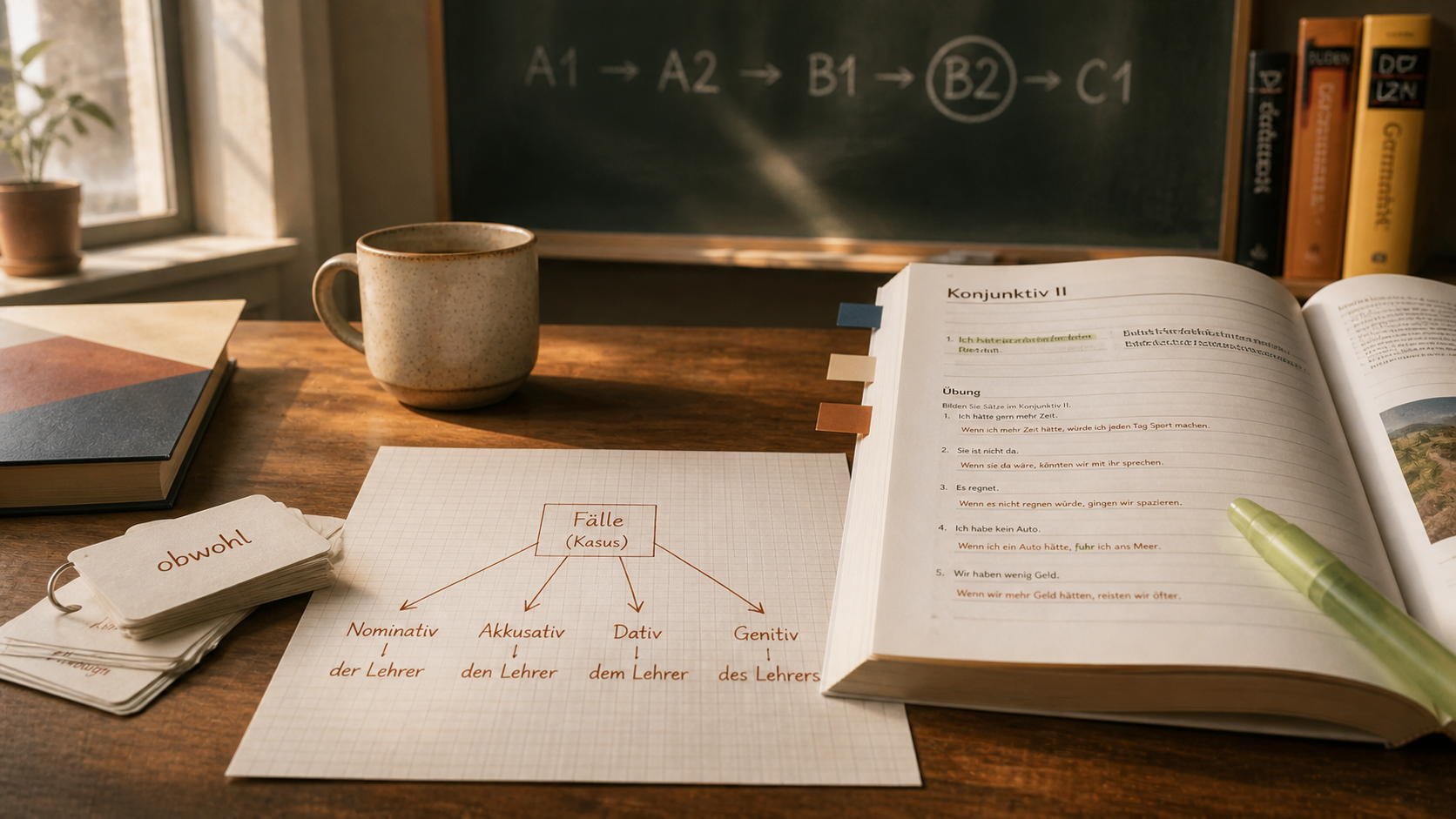
- A pacing structure that doesn't leave you guessing. Our A1 and A2
blocks run 8 weeks each; B1, B2 and C1 run 12 weeks. You always know where you are in the curriculum and what week 7 looks like before you
start. - A consistent coursebook. We use Netzwerk Neu (Klett) as a spine
and supplement it heavily — but having one durable reference matters
more than people expect. - Realistic exam targets. Most adult learners reach B1 in 8–12
months of part-time study (~6h/week). C1 in 18–24 months. Aim for a
telc certificate every level so the progress is visible and
transferable.
Where to start
If you're brand new, our German courses (A1–C1)
are the fastest way in. If you're a doctor or a nurse heading for
Approbation, see
German for Medical Professionals.
If you're a resident in Germany already and want a Bildungsgutschein-funded
intensive course, we have a dedicated track for
residents — same structure,
funded.
Or just book a placement test and we'll tell you which
level fits, in plain English, in under twenty minutes.
Whichever path you pick, the answer to Why learn German? in 2026 is the
same as in 1996: because it pays for itself, in money or time or both.
The only thing that changed is how easy it is to start.